
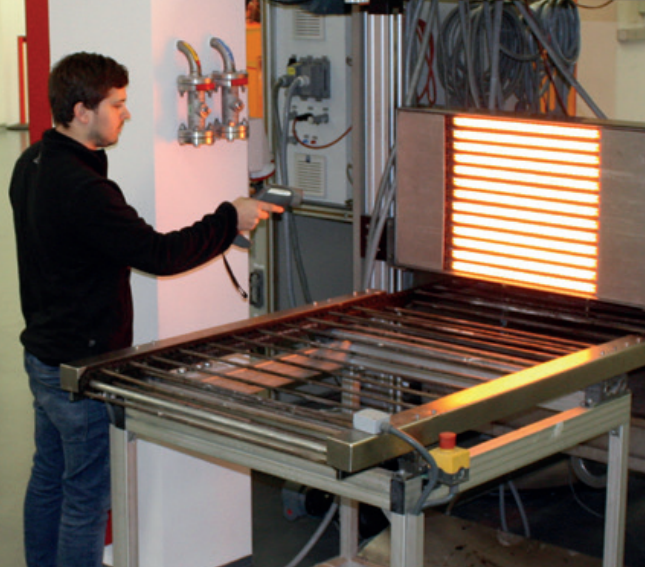
Out on the lithography floor, a wafer comes out of the clean bath soaking wet. If the IR dryer can’t keep up, you’re left with watermarks, photoresist won’t stick, and the line grinds to a halt. We built our wafer-drying infrared heaters to stop that failure before it starts.
What matters under the hood
We run short-wave infrared quartz emitters, so energy hits the wafer directly and fast, and the substrate stays cool. You get wafer-level thermal uniformity within ±0.1°C across the process window, which keeps soft bake and hard bake profiles right where they need to be. Output stays stable over 5,000+ hours with less than 5% intensity drift, so repeatability doesn’t fall off over time. The heater module sits comfortably in Class 1–100 cleanrooms and is built to generate zero particles—confirmed by particle count monitoring right at the point of use.
Why this works in practice
In wafer drying, temperature control is the thermal budget. Our IR heaters deliver heat that’s consistent and repeatable, so wafers dry quickly, carry-over defects drop, and throughput climbs without spiking energy draw. You see faster cycle times, fewer scrapped lots, and less maintenance because the emitters have long life and the thermal profile stays stable. The design is a verified equivalent to international semiconductor equipment standards, so it drops in as an interchangeable, validated option for your existing platforms.
What you need to know up front
Installation comes down to matching the tool’s mechanical interface and control signals—usually 24 V logic and shielded cabling to keep EMI out. The heater hits full temperature in seconds, so the process controller needs tuning to avoid overshoot during warm-up and recipe transitions. In high-humidity bays, make sure local condensation is managed; the emitter window has to stay clear to keep IR transmission steady.