
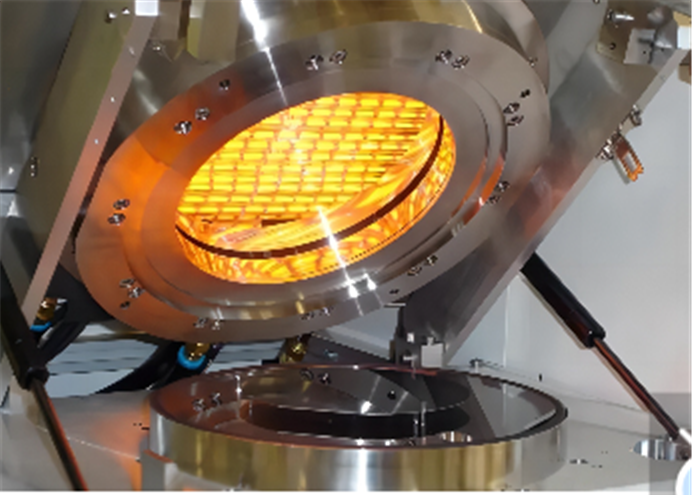
On the fab floor, thermal drift during wafer drying is the one thing a lithography cell simply can’t afford. Even a few degrees of non-uniformity across the photoresist surface will show up as overlay errors and bleed straight into yield. We built our industrial wafer drying heaters to take that variable off the table.
Infrared Precision: Sub-Millimeter Control You Can Count On
We run short-wave infrared emitters through an engineered optical train to shape the thermal field with sub-millimeter spatial control. The payoff is wafer-level temperature uniformity within ±0.1°C across the process window, and repeatability that holds up shift-to-shift, lot-to-lot. Soft bake and hard bake profiles stay stable, CD control tightens, and the thermal budget stays inside spec. Over 5,000+ hours, output stays steady with less than 5% intensity drift, and the system is built to run 24/7 without unplanned downtime.
Why It Fits High-Yield Semiconductor Drying
These heaters were designed around the realities of production wafer drying: zero particle generation, cleanroom compatibility from Class 1 to Class 100, and fast thermal settling that cuts cycle time without stressing the films. Infrared response is immediate and clean, so residual solvents are driven off uniformly, and edge bead removal stays predictable. You end up with tighter process windows, fewer reworks, and lower energy per wafer because the heat is delivered on demand—no wasted thermal mass.
Installation and Operating Notes
Expect disciplined integration. The heater has to be aligned to the dryer chamber’s optical axis, and cooling has to hit the specified flow and temperature. Misalignment or insufficient cooling will degrade uniformity. Before installation, confirm voltage and connector compatibility with your platform. Then plan routine emitter inspections at the recommended interval to keep that ±0.1°C uniformity where it needs to be.