
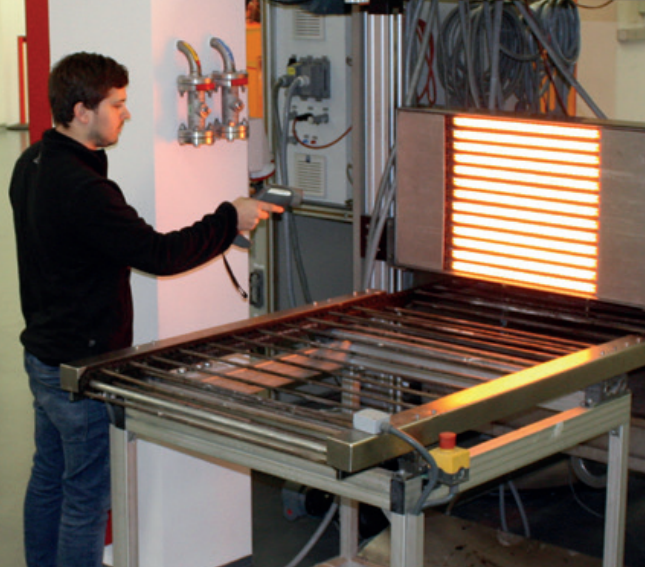
On the fab floor, we don’t treat photoresist bake as “just” a thermal step. It’s a dimensional lever. A 2°C drift in soft bake or hard bake will move your CDs, leave scum at the interface, and make yield feel like it’s on a knife-edge every shift. Medium wave quartz heater tubes are the practical way to pull that variability out of the equation. What actually matters is control at the wafer level. Medium wave IR couples cleanly into photoresist and quartz, giving you fast, resistive heating with low thermal inertia. You end up with a stable bake profile and wafer-level uniformity within ±0.1°C, plus repeatability that holds up shift-to-shift and lot-to-lot. The tube stays clean, too: high-purity quartz engineered to keep outgassing down and stop particle generation, so you’re not fighting contamination while you chase critical dimensions. And it fits the thermal discipline of semiconductor processing. In lithography tracks, the medium wave response gives you crisp, fast temperature ramps for soft bake and hard bake without overshoot, so you protect the resist stack and the films underneath. Cleanroom Class 1–100 compatibility isn’t a sticker—it’s built into the joints, terminations, and surface finish. Run it 24/7 and the heater holds setpoint stability, which keeps your process window predictable and cuts down on excursions. That shows up as higher throughput, less scrap, and fewer reworks. One thing to keep straight: medium wave quartz heaters deliver speed and precision, but they need proper thermal coupling and mounting. Surface contact and alignment have to be tight. If they aren’t, you’ll see local hot spots and drift even when the heater itself is stable. Spec the right flange, gasket, and instrumentation, and verify the bake chamber geometry so the thermal path stays repeatable.