

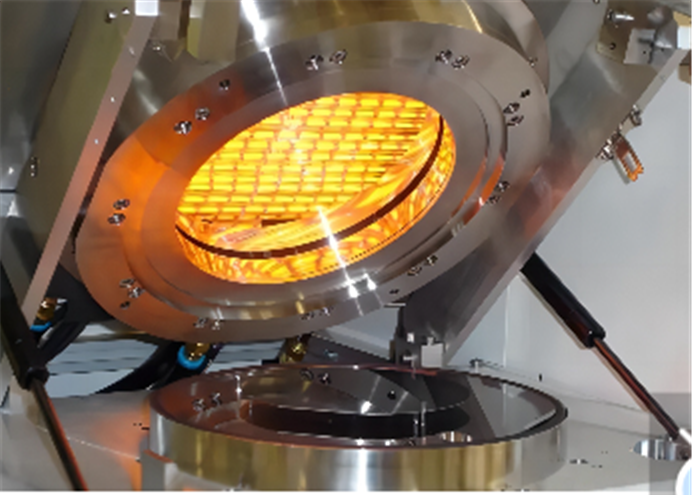
On the lithography floor, you can’t afford thermal drift in the photoresist strip chamber. Temperature spread shows up as residue, pattern damage, and yield you’ll never recover. We built the strip heater to hold process temperature with discipline—so the chemistry does its job and the wafer comes out clean. What matters under the hood The unit uses short-wave halogen heating through a quartz window, so response is fast and output stays steady. Across the wafer, thermal uniformity is held to ±0.1°C, and repeatability stays tight run-to-run so bake profiles don’t drift. The heater body is compatible with cleanroom Class 1–100, and every surface is finished to keep particle generation low. In practice, that means fewer defects, tighter CD control, and strip results you can count on. The system runs 24/7 with no unplanned downtime, and the thermal budget per cycle stays within spec. Why this works in real photoresist processing The strip step comes after soft bake and hard bake, when residual films are touchy—hot spots and cold edges will bite you. Our heater holds the chamber at setpoint without overshoot, so solvents evaporate evenly and polymers lift clean. You get faster cycle times because the ramp is controlled, and you save energy because the heater comes up quickly and then holds steady. Process windows widen, rework drops, and the line keeps moving. Things to keep straight on install Match the chamber footprint and connector interface—we provide dimensional drawings and pin maps for the common strip tools. The heater hits rated performance only when chamber seals are good and gas flow is balanced. After maintenance, expect a short warm-up to re-stabilize the profile. Alignment during integration has to be dialed in to keep the specified uniformity window.